Read the following passage.
It was about 6 in the afternoon that I sat at the window and looked outside. I saw that my neighbor’s little child and his dog were playing in the garden. The child was running around the garden and the dog was following him.
In the passage above, sat, looked and saw are written in past simple while the verbs were playing, was running, and was following are all in past continuous or past progressive form.
Past Continuous: Positive, Negative, & Questions
Past continuous form of a verb follows this structure: ‘was/were + verb-ing’.
We were sitting in the balcony having our evening tea.
Yesterday this time, I was sitting at my desk at work.
The negative form of a verb in past continuous is made by adding not to the auxiliary was or were.
I waved to you but you weren’t looking. (weren’t = were not)
The TV was on but I wasn’t paying attention. (wasn’t = was not)
To make the question form of a verb in past continuous, we move the auxiliary was or were before the subject of the verb.
Were you hiding something when I got home?
Why was she talking on the phone all the time?
Were they listening to our conversation all this time?
What were you looking at in that room?
When to Use the Past Continuous
I. We use past progressive to say that something was going on (continuing) for a while or around a particular time in the past.
I was reading your report the whole evening, and I need to talk to you about some of the details.
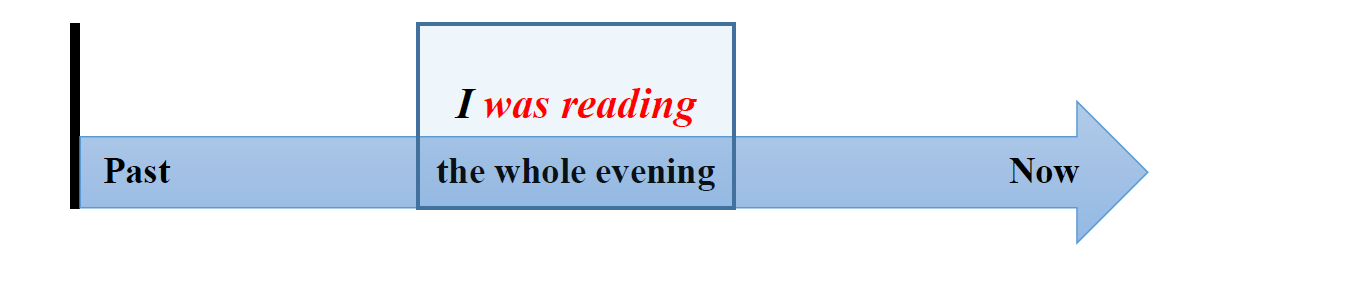
At the weekend, I was preparing for the exam.

II. Usually, we use past continuous with another verb in past simple to show that they happened at the same time. In this case, the background action, the one that starts first and continues for longer, is in past continuous form. Also, the action that starts later or in the middle of the longer action is in past simple.
When I was driving home, I received a phone call from the office.

As we were walking down the hill, we saw a strange light in the sky.
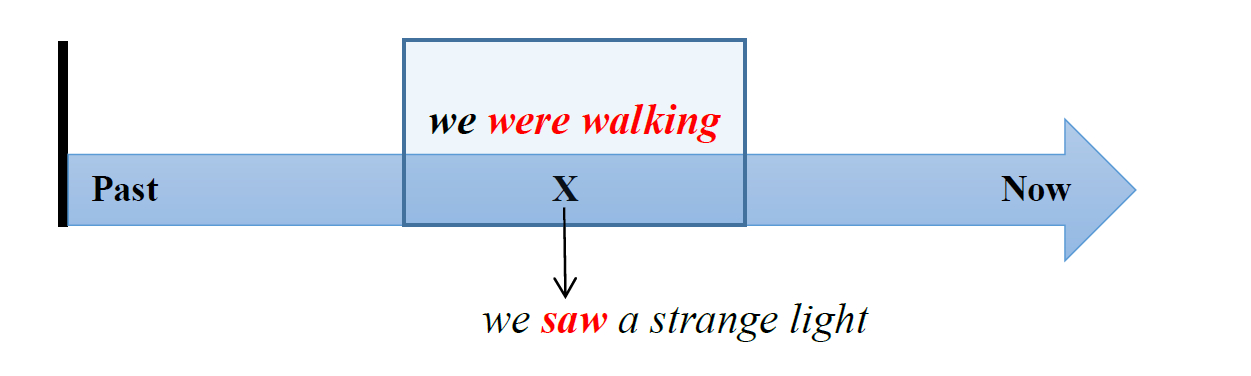
Note that if both past actions continue, we can use past continuous for both.
I wasn’t thinking about anything while I was reading the book.
Were you listening while he was talking about his childhood?
III. We use past continuous for temporary past actions. This means that the action continues for a while but it is not a repeated action nor a permanent one.
When I was travelling with him, I got to learn a lot of things about him.
The two actors fell in love while they were filming their recent movie in Hawaii.
Action vs State Verbs in Past Continuous
Note that some verbs are not used in continuous or progressive form. So, we use these verbs in past simple. Some of these verbs are listed below:
believe, love, like, hate, feel, know, understand, need, consist of, remember, seem, prefer, contain, belong, want, own, mean, …
He was trying his best to explain everything simply but honestly, I didn’t understand anything. (NOT wasn’t understanding)
Note that while talking about a number of past events, the actions that we refer to in past continuous are not the main information we are giving. In fact, the main actions are mentioned in past simple.
Actually, he was talking about why he decided to change his job and how he managed to find his new job.